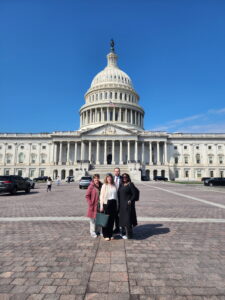
Jennifer Barborak (BRHF), Abigail Vanim (American Eagle Foundation). Philip Kock (Pittsburgh Community Foundation), Amber Farr (Grantmakers of Western PA) on their way to the Capitol in March.
Earlier this year, our Executive Director, Jennifer Barborak, attended the annual Foundations on the Hill in Washington, DC to represent the communities Buhl Regional Health Foundation serves. This intentionally designed, forward-looking advocacy conference and experience was a critical opportunity to educate lawmakers about the importance of allowing all foundations the freedom to support community organizations that are doing work related to their missions, without interference.
What follows are Jennifer’s reflections on this trip, what was learned from this opportunity, how working with politicians connects back to our community, and how these perspectives reinforced why foundations are important for long term wellbeing.
Set the scene: For you, what was the atmosphere at Foundations on the Hill 2026?
It’s hard to describe the rollercoaster of emotions I felt arriving at Foundations on the Hill in Washington, DC in March 2026. It’s one thing to visit our Nation’s Capital as a tourist. It’s a whole other feeling of empowerment and inspiration to be there to advocate for change with 400 other foundations and non-profit leaders from across the United States. I have spoken publicly most of my adult life, but nothing could have prepared me for the intensity of speaking to our congresspeople in the Senate and House. My biggest fear was that I would not be able to speak intelligently enough about the needs of our sector and my community. However, once I realized I knew more about what I was advocating for than they did, I found in myself a profound sense of civic responsibility and passion for my community. Once I realized that congresspeople are here to represent us, and they don’t know enough about us unless we tell them, I was able to speak from the heart and talk about the needs of rural Western Pennsylvania. I was surprised at how friendly and attentive the staffers were, and they were genuinely interested in what we were saying. Several asked follow up questions that let us know they were truly interested and listening.
How did you connect what is happening in Washington, D.C. with needs in the Mercer County region?
Being at Foundations on the Hill allowed me the opportunity to be a bigger part of the field of philanthropy. It was amazing to find myself surrounded by people who think like me and who were advocating for the same thing I was, hundreds of people. To walk into a room with several hundred people and know that there were people from all walks of life, democrats, republicans, all races and ethnicities, and we were all working together for a common cause gave me an overwhelming sense of belonging. The first two days of preparation were exhausting, but necessary. It taught me that no matter how small or big a foundation is, no matter how many people you have working with you, no matter the size of your community, we are all a part of a sector. We are all part of philanthropy. And being together, we can make a difference. It made me realize how important our work is, and how important it is for us to show up collectively to fight for what we believe in.
Why is Collective Support from Philanthropic Colleagues essential at this moment?
Our sector has been under pressure lately. There are attempts to limit what we can fund, threats to increase our excise tax [the federal tax on all foundation’s net investment income that funds regulatory oversight], threats to remove our non-profit status if we fund something the current administration does not agree with. Our sector needs to stand together and advocate for our rights and the rights of the non-profits we support. Many times, non-profits don’t have the ability to take a stand, to assume risk; but we do. We need to ensure we continue to be part of the conversation, especially at gatherings like Foundations on the Hill.
Why are Foundations Important to the fabric of our communities?
A foundation serves as more than just a source of funding; it is the structural backbone of a community’s long-term wellbeing. Unlike organizations bound by short-term cycles, a foundation has the benefit of having the time to deeply analyze the barriers to community wellbeing and focus funding efforts to improve the underlying conditions that are hindering us. By strategically focusing on what isn’t working, we ensure that our resources address the source of a problem rather than merely treating its symptoms.
Our independence is our greatest asset. Free from political agendas or corporate influence, Buhl Regional Health Foundation (BRHF) possesses the unique ability to fund innovative ideas and bridge the gaps that local, state, or regional government programs cannot reach. We are a neutral convener, connecting the dots between social services to eliminate overlaps and fortify the safety net for every community member.
Perspective: From Washington, DC to Mercer County
When I returned to Mercer County, a core part of what I know that also guides BRHF was reinforced: we cannot be effective advocates for our communities without a deep understanding of their needs, and we have to effectively communicate those needs to our politicians. In Washington, I realized that Buhl Regional Health Foundation serves as an essential advocate for our entire region. While federal resources are vast and shifting, philanthropy is a resilient connector that ensures what is happening locally is part of the conversation in our Nation’s Capital.
RESOURCE HIGHLIGHT
In preparation for our time in Washington, DC, we developed materials that highlight our foundation’s work and its impact here in Mercer County, PA, to share with lawmakers. View the Impact Report here: BRHF Lifetime Impact Report