Takeaways from the 2026 GIH Conference and What They Mean for the Future of Mercer County
By Jennifer Barborak, Executive Director, Buhl Regional Health Foundation
As an Executive Director, much of my day-to-day focus is naturally poured into the immediate, vital needs of our local Mercer County community. True progress, perspective, and learning requires us to occasionally step back and look at the larger picture.
These elements are exactly what the 2026 Grantmakers In Health (GIH) Annual Conference on Health Philanthropy offered. As the nation’s largest gathering of health funders, this conference brought together the brightest minds, experts, and innovative practitioners across the sector with a singular, vital mission: advancing better health for all. Attending this year’s event was a powerful reminder that while our communities face distinct challenges, our national network of health philanthropy is arriving at the same crucial realization — that systemic health equity requires bold, shared strategies.
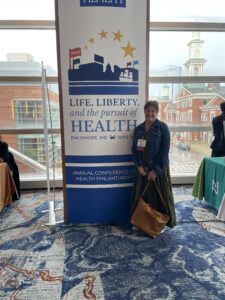
BRHF’s Executive Director, Jennifer Barborak at the 2026 GIH Conference on Health Philanthropy
Here, you will find key takeaways I learned from the front lines of health funding during this conference. I would like to share my reflections on how the insights connect to our Mercer County community and support the ongoing strategic efforts of the Buhl Regional Health Foundation (BRHF).
What was learned, How it Comes Full Circle Back to Mercer County
My goals for this conference were threefold: to forge powerful connections with fellow U.S. health and wellness funders, to gain deep insights into the innovative strategies reshaping community well-being across the country, and to share the impactful, collaborative work we are championing at BRHF — offering our own model as both inspiration and a blueprint for others.
Trust-Based Philanthropy is Not Optional, It is Our Competitive Edge
Many traditional health funders are behind on modern, trust-based philanthropy, streamlined reporting, and community-collaborative models. BRHF is leading in areas where others are just starting to show curiosity. One example is the learning cohort model created as part of our Childcare Expansion Program. This approach sets a new benchmark for operational efficiency and funder-grantee dynamics. By sharing a blueprint for trust-based practices, we can help show the sector how to move away from bureaucratic, low-trust compliance and move toward catalytic funding — which at its core provides capital on the ground faster and more effectively.
Providing Structured Data Systems is the Next Step for Improving Capacity-Building
Grantees are facing a massive data-capacity crisis due to the loss of credible data and increased reporting burdens. If funders don’t intervene, grantees risk losing state and federal funding simply because they lack the administrative bandwidth to prove their impact. This shift helps our industry by redefining what grantee support means. Collectively we must shift the industry from just giving dollars to actively building data infrastructure. By leveraging university partnerships or co-funding centralized datasets, funders protect the entire ecosystem’s financial sustainability and ensure federal rural health dollars actually land where they are intended, rather than being spent inefficiently.
Health is Not Separate from Democratic Infrastructure and Courageous Advocacy
The health sector cannot remain neutral or passive in the face of systemic inequities and rising restriction of individual civil liberties. Healthcare should be a right, not a privilege. True community health is not a zero-sum game, where one person’s gain is another’s loss. Improving the health of all of us, including traditionally marginalized groups (e.g. transgender people, immigrants, ethnic and religious minorities, among others) strengthens the entire system. Rebuilding broken, legacy models like closed hospitals can be a trap; the goal must be reimagining health hubs based on actual, current community needs, informed by our collective communities. Courageous advocacy provides the industry with a brave, non-partisan vocabulary to address systemic threats. It frames advocacy not as a political stance, but as a clinical and public health necessity. This empowers other funders to move past discomfort, speak up against inequities, and fund innovative infrastructure (like public telehealth rooms in libraries or schools) that meets people exactly where they are.
Where Do We Go From Here?
We are at a moment for courageous opportunity and innovation. Our industry is eager for direction on how to reduce grantee burnout, safeguard public funding through better data, and navigate complex socio-political landscapes through an intentional health lens.
BRHF is already uniquely positioned to lead this shift with our trust-based philanthropy approach, learning cohort models, and catalytic strategies which have the ability to capture the attention of our peers, to inspire them and those influenced by the philanthropy sector. Moving forward, BRHF’s true power lies in our ability to leverage our reputation as an innovative leader to bring partners together, protect vulnerable populations, and structurally reimagine community health infrastructure from the ground up.